 Slingshot
 required bridged $SLING and token locks for GameFi-era voting
updated
Slingshot's GameFi-era deposit route moved $SLING from Arbitrum One to its application chain before game voting. The external funding path involved an L2 balance, bridging to the dedicated Arbitrum Orbit L3 and locking tokens for voting power. A deposit alone did not create that power. The app sponsored L3 gas, while the lock restricted token access until expiry. These were historical application requirements; current access to the old deposit interface remains unconfirmed.
Arbitrum Funding and Application Balances
Arbitrum One hosted the externally held $SLING token, while the dedicated L3 supported application activity. The bridge connected these network balances. Locking then committed tokens within the application, creating the power used for game selection. A balance on the starting network, an unlocked application balance and tokens in escrow described different states.
Game voting required the locked state. Merely transferring tokens toward the application did not cast a vote or allocate voting rewards. Those rewards belonged to participation in voting rounds.
The Token and Receiving Network
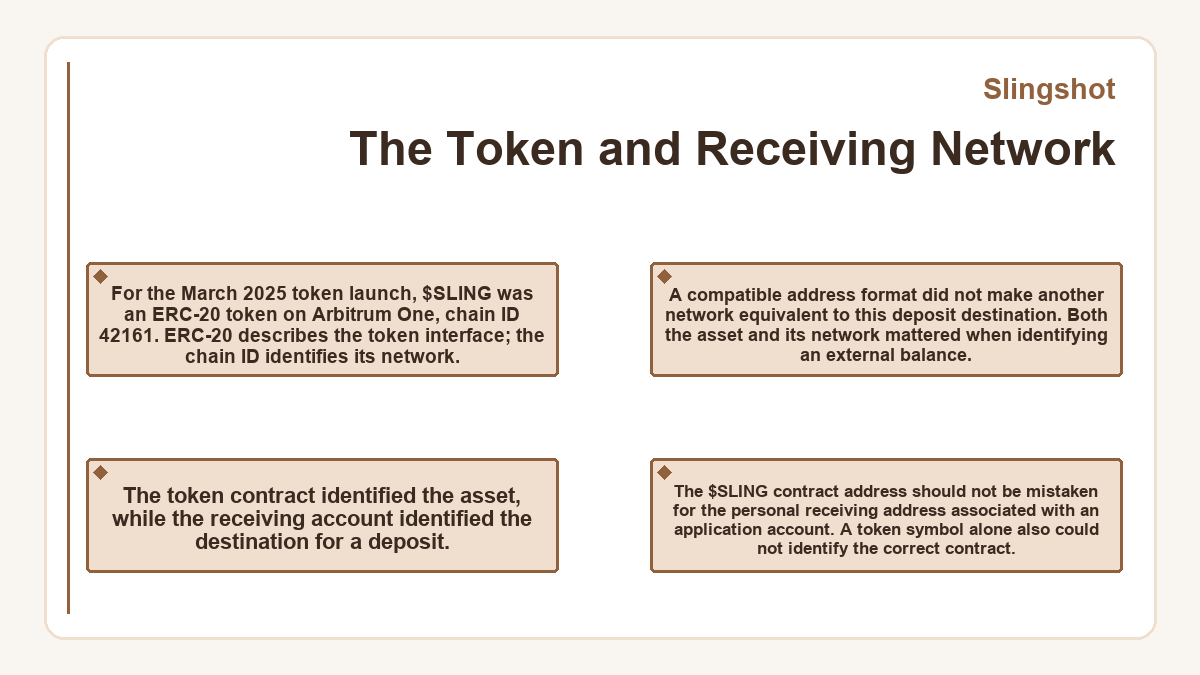
For the March 2025 token launch, $SLING was an ERC-20 token on Arbitrum One, chain ID 42161. ERC-20 describes the token interface; the chain ID identifies its network. A compatible address format did not make another network equivalent to this deposit destination. Both the asset and its network mattered when identifying an external balance.
The token contract identified the asset, while the receiving account identified the destination for a deposit. The $SLING contract address should not be mistaken for the personal receiving address associated with an application account. A token symbol alone also could not identify the correct contract.
Social Login and Deposit Ownership
Web3Auth supplied the historical application's self-custody wallets through social login. Choosing a login created a multiparty computation, or MPC, wallet linked to that social account. The deposit destination therefore belonged to a particular account identity. Logging in through another social account created a different wallet, even when the same person controlled both accounts.
Matching that identity mattered before funding because a balance in one wallet did not become a balance in another. The application also prompted users to configure two-factor authentication, and access depended on retaining the relevant login and authentication factors; a successful sign-in to a different account could show a different wallet and its separate balance.
The operator did not hold recovery keys for these wallets. That limited what account support could restore after access was lost.
Which Transactions Did the Gas Subsidy Cover?
The historical gas subsidy covered transactions on the dedicated L3, where $SLING was the native gas token. The application paid those network charges for users. Ordinary Arbitrum One transactions use ETH for gas, so an external wallet transfer had a different fee context. An exchange withdrawal could also carry the exchange's own charge. Those external charges were separate from the sponsored L3 gas. Gas sponsorship reduced the cost of application interactions; it did not remove the token amount committed to escrow or shorten the chosen lock duration.
When Did a Deposit Become a Time Commitment?
A deposit became a time commitment when its tokens entered a Voting Escrow lock. In the historical application, a wallet could maintain one active lock. The permitted duration ran from a minimum of 30 days to a maximum of four years. Those limits applied to locking, not to the bridge's advertised transfer speed.
The withdrawal restriction attached to tokens in escrow. An unlocked balance remained outside that lock.
Funding Decisions Before Any Transfer
Consider a reader who wants to inspect the deposit route while retaining the option to stop before moving tokens. The reader can inspect the route if the historical interface opens and the intended account can be identified. Reviewing its receiving address and the proposed lock terms leaves the tokens uncommitted. This inspection precedes any authorization to move a balance.
- Match the receiving wallet to the social account intended for participation.
- Confirm the starting balance is the Arbitrum One $SLING token.
- Establish whether the historical L2-to-L3 bridge is accessible before funding.
- Identify the amount proposed for escrow and its lock duration.
- Reject the lock if access to those tokens is needed before its expiry.
A matching wallet and an acceptable lock duration establish readiness to consider funding. They do not mean a deposit or lock has occurred. Until the reader authorizes an operation, reviewing those details need not alter either the token balance or the existing lock.
The reader should stop before funding if the bridge is inaccessible or the receiving wallet belongs to another account. A need for early withdrawal rules out the proposed lock. Once tokens enter escrow, the lock's withdrawal restriction replaces that freedom to change the plan.
Private-Sale Claims and External Funding
Eligible NFT Holder Private Sale participants had a claim route distinct from an external deposit. The historical portal offered Claim and Stake, which claimed and automatically staked tokens, alongside Just Claim, which produced an unlocked balance. The chosen option took effect when the claim completed. The sale wallet established eligibility, while the selected claim option determined the balance's state. These options applied to eligible sale allocations; they did not describe every external transfer or ordinary deposit.
Returning Unlocked and Expired Balances
The historical bridge supported moving unlocked application tokens back to Arbitrum One. Escrow release followed a separate restriction. Locked $SLING could be withdrawn only after the lock duration expired. The lock did not permit partial withdrawals. Its full release and a return across networks addressed different states: release removed the escrow restriction, while bridging changed the network holding the usable balance. The return route still required access to the relevant wallet and functioning bridge infrastructure.
Smart Accounts Behind the Bridge
The historical bridge combined MPC wallet technology with ERC-4337 smart accounts. ERC-4337 supports account abstraction, allowing smart accounts to define their authorization logic. Social authentication, account authorization and bridge execution had different roles, even where an interface simplified their presentation.
New deposits would require a functioning application and bridge for the intended account. Current access to that historical interface remains unconfirmed.
Slingshot - your questions answered
Which Contract Identified the Arbitrum One $SLING Deposit Token?
The GameFi-era $SLING token used Arbitrum One contract 0x5F8a7c646511A790C53F171891E5d469cA884EdE. This identified the ERC-20 asset on chain ID 42161. It was a token contract address, not a personal receiving address for funding an application account.
Could an Existing Lock Accept Additional Deposited Tokens?
The historical Voting Escrow allowed a wallet to add more $SLING to its existing lock. The added tokens joined that commitment instead of creating a second concurrent lock. The existing withdrawal restriction continued to matter when deciding whether to commit an additional balance.
Did Every Deposit Have a 60-Day Migration Wait?
The 60-day wait concerned migrating unlocked Polygon tokens without locking them. The historical migration allowed already locked tokens to migrate immediately and remain locked. Unlocked holders could also choose immediate migration with locking. That rule was specific to the Polygon migration.
Were the 2025 Airdrop Tokens Locked Automatically on Claim?
The 2025 airdrop tokens were unlocked upon claim. Receiving that distribution therefore did not automatically create the token lock required for game-voting power.
Could a Private-Sale Allocation Remain Unclaimable After Its First Release?
Some NFT Holder Private Sale tokens became claimable only at later scheduled releases. The schedule listed 33% at the March 2025 token generation event, 33% 30 days after that event and 33% 60 days after it. The first claimable balance therefore excluded the later portions.
Was an Exchange Purchase Enough to Fund the Game-Voting Wallet?
An exchange purchase did not by itself fund the historical application's wallet. A trading balance and an application balance belonged to different account contexts. The deposit requirements concerned tokens available to the intended wallet on the specified networks, not merely a completed purchase.