 Slingshot
 voting power depended on locked $SLING and remaining lock time
updated
Slingshot voting power measured the influence a token lock gave its holder in the GameFi-era application. Its escrow calculation used the locked $SLING amount and the time remaining before a weekly-rounded expiry. Longer remaining commitments produced more weight for the same token amount. Game-voting rounds could preserve a stabilized score, while governance used the value when its vote began.
Table of contents
The GameFi application connected this weight to game-funding choices and DAO governance. Current access to that application and new voting rounds remains unconfirmed. Historical lock arithmetic therefore does not establish a present opportunity to vote.
Differences Between Escrow and Round Scores
An active lock's escrow calculation described its weight at a particular time, while a game round could retain a higher stabilized score. When the figures differed, checking the vote type and calculation times helped explain the gap. Comparing a round score against a later escrow value could create an apparent error. Increasing a lock changed its commitment; it did not establish the earlier figure was incorrect.
Locked Amounts and Remaining Time
The historical locking model combined a token quantity with a time commitment, making both inputs relevant to the influence a wallet could exercise.
Tokens in Voting Escrow
The Voting Escrow contract held the locked balance and calculated its power. An unlocked wallet balance did not supply the formula's locked-token input. Increasing the committed amount increased weight when the remaining duration stayed the same. This relationship made token deposit requirements relevant before a lock existed, although a deposit and a voting commitment represented different states.
Lock Duration and Decay
The GameFi rules allowed lock durations from 30 days to four years, with one active lock per wallet. Longer commitments produced proportionally greater initial weight. Time then reduced the remaining duration continuously, so the underlying score declined even when the token amount stayed unchanged. At expiry, live escrow power reached zero.
How Was Slingshot Voting Power Calculated?
The historical escrow formula multiplied locked $SLING by the weekly-rounded remaining time, then divided by the maximum-duration denominator.
For an active lock: P = (A ÷ 126,144,000) × (⌊U ÷ 604,800⌋ × 604,800 - t).
A represented locked $SLING, U the unlock timestamp and t the calculation timestamp. Both timestamps used Unix seconds; ⌊ ⌋ meant rounding down.
The GameFi-era formula used 126,144,000 seconds as its four-year denominator. It used 604,800 seconds for a week. Mixing days with seconds changed the calculation.
P expressed escrow weight at t, separately from a reward amount or share of votes. The relationship applied to active locks; expiry reduced live power to zero.
Weekly Expiry and Calendar Dates
Weekly rounding could shorten effective remaining time by less than one week, so calendar estimates could overstate escrow weight. The requested date and rounded boundary could differ. Ignoring elapsed time created a separate discrepancy, even when the expiry already matched a weekly boundary.
Game Rounds and Governance Start Times
The Voting Manager stabilized game-round weight, while governance used escrow power at the beginning of its vote, so the same lock served different timing rules.
Stabilized Game-Round Weight
Game-round stabilization prevented ordinary time decay from reducing the score during a round. Adding tokens or extending a lock could increase that score. Withdrawing the entire locked balance after expiry provided a separate exception to the protection against decreases. After a round ended, the system refreshed power to reflect its underlying value, including decay, before the next round began. This mechanism removed the incentive to vote immediately merely to outrun the lock's falling live score. It preserved weight within the round without freezing the escrow clock.
Governance Weight at Vote Start
Governance followed a different timing boundary: it used the real-time value when the governance vote began. A stabilized showcase score therefore could not substitute for the relevant governance weight. A later lock increase did not describe the balance at an earlier vote-start timestamp. Historical comparisons needed the start time of that particular vote, rather than the time a calculator happened to run.
Lock Increases and Token Access
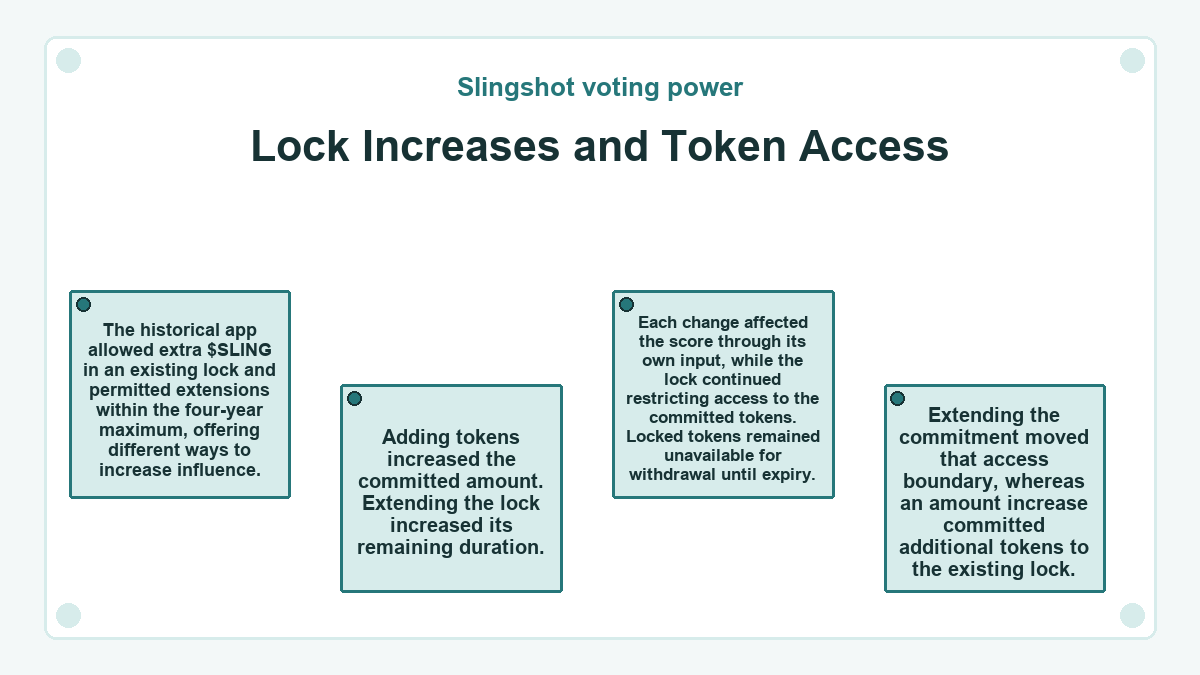
The historical app allowed extra $SLING in an existing lock and permitted extensions within the four-year maximum, offering different ways to increase influence. Adding tokens increased the committed amount. Extending the lock increased its remaining duration. Each change affected the score through its own input, while the lock continued restricting access to the committed tokens.
Locked tokens remained unavailable for withdrawal until expiry. Extending the commitment moved that access boundary, whereas an amount increase committed additional tokens to the existing lock.
Voting Share and Reward Allocation
The reward calculation used a voter's share of deployed round power, making participation and the available reward pool relevant alongside the wallet's own score.
Deployed power meant the weight participants actually used in that round. Total ecosystem power also included weight available from locks whose holders did not vote. The reward relationship was the voter's deployed power divided by total deployed power, multiplied by the rewards available for distribution. Substituting all ecosystem power for deployed power changed the denominator and produced a different calculation.
Participation also affected the amount of rewards the system distributed, and unused allocations could roll into later rounds. A lock's raw score therefore did not establish a fixed $SLING payout. Comparing rewards across rounds required the relevant participation and allocation conditions, even when the holder's own committed token amount remained unchanged.
Governance Weight and the 2023 Investor Cap
The 2023 Investor Cap limited combined governance voting power for investors, advisors, contributing visionaries and venture capital holders to 40% of the total.
If the group's combined weight exceeded that limit, the model adjusted its voting power proportionally. This was a collective cap on a defined group, distinct from the escrow formula for an individual lock. Applying 40% as a universal multiplier to every wallet's score would misread its purpose. The cap also concerned governance, so it did not establish the calculation for a game-voting round.
A generic lock calculation could not establish whether a later balance belonged to the capped group or whether a subsequent deployment retained the same allocation treatment.
Decisions for an Existing Lock
A reader interpreting an existing lock could first calculate its live weight without adding tokens or extending the commitment. With an unchanged amount and expiry, a decrease matching the formula was consistent with time decay. Comparing that observation with the relevant round or vote-start value helped assess whether the difference needed further explanation.
- Continue the escrow calculation when the recorded amount, expiry and calculation time identify the same active lock.
- Use the weekly-rounded expiry when comparing arithmetic with an escrow value.
- Accept ordinary decay when the amount and expiry remain unchanged and the decrease matches the formula for the elapsed time.
- Wait for a subsequent round's refreshed value, if another round opens, to compare it with escrow power at the refresh timestamp.
- Stop carrying an expired lock's former live score into a live escrow calculation or a governance vote beginning after expiry.
A historical positive score alone could not confirm an available voting round. Resolving a timing difference before changing the lock avoided adding a commitment solely to reproduce a score from another voting context.
Slingshot voting power: what people ask
Can a Token Price Replace the Amount in the voting-power Formula?
The formula used the number of locked $SLING tokens, not their market value. Converting that amount into a currency value would change the input's meaning. Token prices could move without altering the committed token quantity, so a price change alone did not increase the escrow's underlying voting weight.
Did Casting a Game Vote Spend the Locked $SLING Principal?
A game vote used voting weight while the underlying $SLING remained in escrow. The token commitment continued until its unlock boundary; casting a vote did not withdraw the tokens. A declining live score reflected the passage of lock time, so it did not by itself show a smaller principal balance.
Could the Same Lock Support Another game-voting Round?
An unexpired lock could supply refreshed voting power when a subsequent game round opened. Each new round used the updated value, including the decay accumulated during the preceding round. Reusing the lock therefore did not mean reusing its original score or creating another token commitment.
Which Early Token Holders Were Excluded From game-idea Voting?
The 2023 model excluded the investor-cap group from the app's game-idea electorate. That group comprised investors, advisors, contributing visionaries and venture capital holders. Their capped governance weight did not become showcase voting power. The 2023 exclusion did not establish voting eligibility for later token balances or allocations.
Did Positive Voting Power Remove Proposal Sponsorship Requirements?
Positive voting power alone did not establish a right to bypass proposal sponsorship. The governance framework called for a sufficiently high threshold permitting direct vote authorship. Its ordinary route required at least two sponsors from serving Guiding Contributors or Special Council members. Calculating escrow power did not establish proposal-authoring eligibility.